

Muscle is the tissue that decides how you age. It stores your blood sugar, protects your bones, and keeps you carrying your own suitcase at 70. Women lose 3 to 5 percent of it every decade starting around age 30, and that loss speeds up through menopause. Strength training rebuilds it at any age.
It leaves quietly. Muscle, we mean.
Nobody wakes up at 47 and notices that a pound of it is gone. What our ladies notice is the jar lid that will not turn, and the second suitcase they hand off at the bottom of the stairs in Rome, and the way they got winded carrying the laundry basket up from the basement. They have done everything they were told to do for twenty years, walking 12,000 steps, eating less than their teenage daughter eats, staying off the bread, and the body still feels softer and slower and less reliable than it did at 35.
That is not a willpower problem and it is not a metabolism that broke. That is muscle, and it is the one thing almost nobody told women to protect.
What Muscle Does That Has Nothing to Do With Looking Toned
Muscle is where your body parks the carbohydrates you eat. When there is plenty of it, that bagel and that pasta have somewhere useful to go, and your blood sugar stays steadier through the afternoon. When there is less of it, the same food has fewer places to land, and more of it gets stored as fat instead.
It is also the reason you can get up off the floor, which sounds small until you are 72 and it is the whole ballgame. Muscle is what lets you catch yourself when the stair is not where you thought it was, and it is what lets you lift a grandchild without thinking about your back first, and it is what keeps you loading your own carry-on into the bin on a trip you saved five years for.
The research bears out what we watch happen in real life. According to the Office on Women's Health, women start losing about 3 to 5 percent of their muscle mass per decade beginning around age 30, and those losses become obvious enough to interfere with walking, standing and carrying groceries by 60. What makes it worse is that strength drops faster than mass does. One quantitative review of the research found strength is lost two to five times faster than muscle size, and that losing strength predicts disability and death more consistently than losing mass does.
What Perimenopause Does To The Timeline
Estrogen does more than run your cycle. It helps protect muscle tissue, and when it starts dropping through perimenopause, that protection goes with it. The loss that had been slow and quiet since your thirties picks up speed right at the moment most women are the busiest they have ever been, and it is a big part of why weight loss changes in perimenopause.
The consequences are measurable. A 20-week trial published in BMC Women's Health reported that postmenopausal women with reduced muscle mass had 2.1 times the risk of falling and 2.7 times the risk of a bone fracture compared with women who had held onto theirs. Same age. Same everything else. The difference was muscle.
The doom content leaves out the other half of that research. The menopause transition does not stop you from building. Women in their forties and fifties, pre, peri and post, respond to resistance training. The window did not close on you. It just stopped being optional.
Muscle is the retirement account nobody told women to open, and the good news is you can still make deposits at 52.
Why Cardio And Eating Less Made It Worse
Most of our ladies arrive having done the exact opposite of what their body needed, and they did it because that is what every magazine told them for two decades. Eat 1,200 calories, run five days a week, and do not touch the weights because you will get bulky.
That combination takes muscle. Not fat first, muscle. When you undereat protein and pile on hours of steady cardio, the body pulls from the tissue that costs the most to maintain, and you end up lighter on the scale and softer in the mirror at the same time. That is the moment women tell us the number went down and they still hate how they look, and they think something is wrong with them.
Nothing is wrong with them. The plan was wrong. It was built to make the scale move and it did, by taking the thing that keeps you strong at 80.
We do not do that here. There is no wagon to fall off, there is no earning your dinner, and there is no version of this where you eat 1,200 calories and call it health. The 80-20 lifestyle exists because food you look forward to is part of a plan you can still be doing in ten years, and ten years is the only timeline muscle cares about.
How Much Lifting It Takes, And It Is Less Than You Think
The number that surprises people is small. A meta-analysis of 16 studies published in the British Journal of Sports Medicine found that muscle-strengthening activity was linked to a 10 to 17 percent lower risk of all-cause mortality, cardiovascular disease, total cancer and diabetes, with the biggest benefit landing at roughly 30 to 60 minutes a week. Not per day. Per week.
Thirty to sixty minutes a week is two or three sessions, and it is less time than most women spend on the treadmill in a single Tuesday.
What matters is what happens inside those sessions. Lifting a three-pound dumbbell for 20 reps while you watch the news is movement, and movement is good, and it is not the stimulus that builds muscle. The stimulus is a weight heavy enough that the last two reps are hard and your form is the thing deciding when you stop. Then next week, or the week after, that weight goes up a little. That is the whole mechanism, and it works whether you are 42 or 58.
Our ladies see it in their own numbers. One VIP member described the change as "significant muscle gains, stronger." Another told us, "I have definitely improved my strength, mobility, and overall fitness." A woman coming up on a year with us wrote that she had lost inches and gained strength and muscle after being stuck for a long time.
Protein Is The Other Half, And The Wine Still Fits
Lifting sends the signal and protein is the material, and without enough of it you are asking your body to build a room while handing it half the lumber.
Older bodies also need more of it than younger ones to get the same response, which is a real physiological shift and not an excuse. The PROT-AGE position paper puts the per-meal threshold at roughly 25 to 30 grams of protein for adults over 65, and the same anabolic resistance starts creeping in well before that birthday. For most of our ladies that lands at 30 grams a meal, three times a day, which looks like a real breakfast instead of coffee until noon.
Thirty grams is a chicken breast the size of your palm, or five eggs, or a cup of Greek yogurt with a scoop of protein powder stirred in. It is turkey and sweet potato chili on a Sunday that feeds you again on Wednesday. It is not a shake diet.
And a 6 oz glass of Sauvignon Blanc runs about 150 calories, and it fits, and you log it toward your carbs or your fats and you go enjoy your girls' night. Alcohol will never count as protein, which is a shame, and it also does not have to leave the table for you to build muscle.
Progress over perfection, every time.
What To Track When The Scale Refuses To Move
A woman doing this correctly will sometimes see the scale hold flat for six weeks while her jeans get loose, because muscle takes up less room than the fat it replaced. If that number is the only thing she is watching, she quits at week five, three weeks before the payoff.
Don't get on that scale. Track these instead.
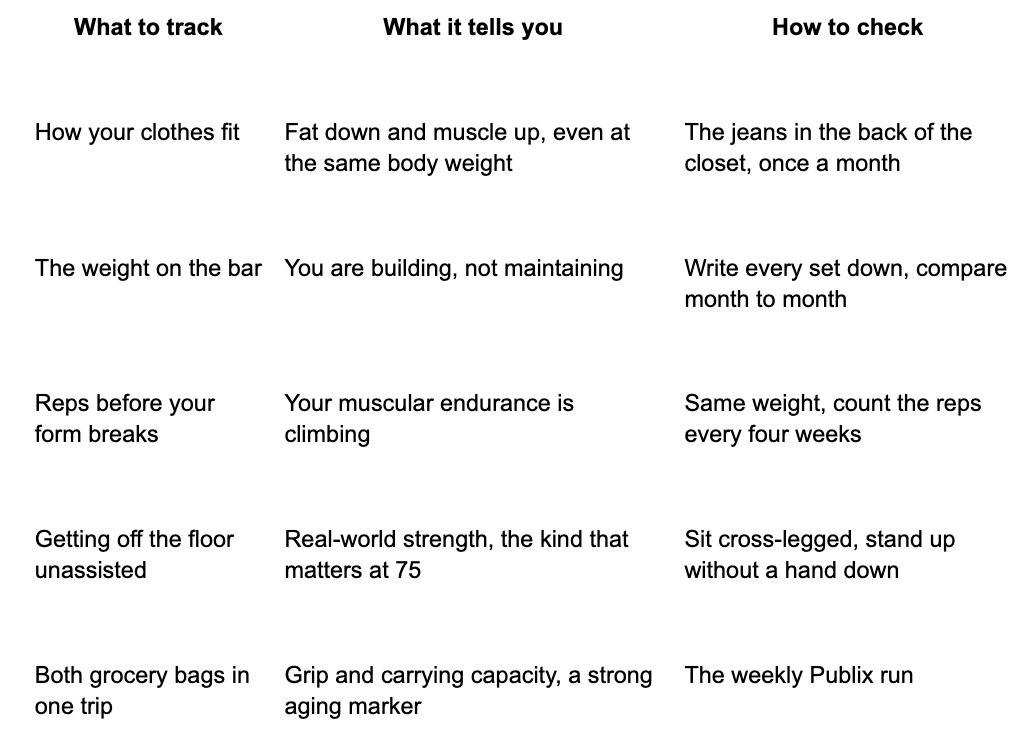
Getting Started With Muscle After 40
You do not need a gym membership or a spare hour in the middle of a workday.
Start with two sessions a week. Two is a number you can protect during a week with a game on Thursday and your mother-in-law in town. Three is better once two is automatic, and going from zero to five days is how women quit in February.
Pick compound movements and write the weight down. Squats, rows, presses, hinges, carries. Five movements that use a lot of muscle at once beat fifteen that isolate small ones, and the written log is what tells you it is working when the mirror is lying to you.
Get 30 grams of protein at breakfast before you change anything else. Most women are eating almost all of their protein at dinner, which leaves the whole morning without the signal to build. Breakfast is the easiest meal to fix and the one that changes the most.
Give it twelve weeks before you judge it. Muscle is slow. Strength shows up in about four weeks, the way your clothes fit follows, and the woman who quits at week six never finds out what week twelve looked like.
Ready To Stop Guessing And Start Building?
Two coaches, real food, a plan built for a body in perimenopause, and a group of women doing it alongside you. That is what our VIP membership is, and it is where the women in this post got stronger without giving up the wine or the pizza or the dinners out.
One VIP member put it better than we could when she described us as coaches who understand you want balance in life, enjoying some cocktails, not depriving yourself, and getting stronger and leaner at the same time. That is the whole thing. We are your gals.
